Tolerated Margins of Mess Pt. 1
Artist Robert Colescott dives headfirst into the absurdities of human existence, uncovering the messy, contradictory connections between belief and action, individual and society, and desire and ethical constraint. His paintings illuminate what writer Barbara Babcock describes as “a tolerated margin of mess”—those chaotic, in-between spaces where opposites clash and the usual rules of social order break down. In these peripheral spaces, the roles of the trickster and the nonconformist converge: to provoke, unsettle, and defy convention, ultimately driving genuine societal change for the better.
Colescott’s subversive paintings are worlds saturated in satire, where mischief and transgression are not mutually exclusive. He colored outside the lines of societal norms, mocking our self-insulating insistence on comfort and safety. With a wink and a mischievous smile, he wielded a palette of racist narratives through stereotypical images, a rogues’ gallery of paradoxes strutting through surreal “Taboos’R’Us” pastiches or bucolic settings—most cloaked as stereotypes, others in Disney day-glo—behaving in ways we would rather not know about. Are women sexually harassed or willing participants? Is the Black man a victim or the aggressor? Are we trapped in history, or is history trapped in us? Our society is tightly knotted; we can’t afford to stay within our own narrow perspectives. More than one story always exists. Viewers react with confusion and distrust, rarely perceiving any deeper meaning. Colescott’s dichotomies are not meant to be understood concretely, but to be unmasked as façades—cutting past media spin and capitalist superficialities, past the weight of history and sheer complacency. These are the mechanisms that keep us trapped.
Although Colescott lays waste to our preconceived notions of social order, his margins of mess do not remain confined to the canvas but draw the viewer into their disorder. Stereotypes only work because we recognize them; in fact, we have internalized them to such an extent that they elicit shame, guilt, and pain—an active form of participation. They are reminders of the exploitative and violent systems deployed to subjugate African Americans into an inferior species. The impulse is to erase them from society, to protect those they harm. However, stereotypes are just a symptom of a larger, broken system—one that is equal opportunity.
Colescott used the female form to challenge the viewer. His stereotyped, scantily clad women—at times depicted without underwear—flaunt themselves across the canvas before wide-eyed, gawking men, their exaggerated poses heightening the work’s leering amplification of the male gaze. Colescott occasionally included caricatures of himself in the background. Whether this reflects self-critique or a broader societal commentary, his work situates both artist and viewer in the dynamics the #MeToo movement calls to account. In recent years, the movement has been undermined by virulent misogyny at the highest levels of government––the Epstein Files–– and business. OnlyFans illustrates how women’s autonomy is often bound to the commodification of their bodies for the male gaze. Addressing the symptom does not resolve the underlying problem—it’s like silencing an alarm without putting out the fire.
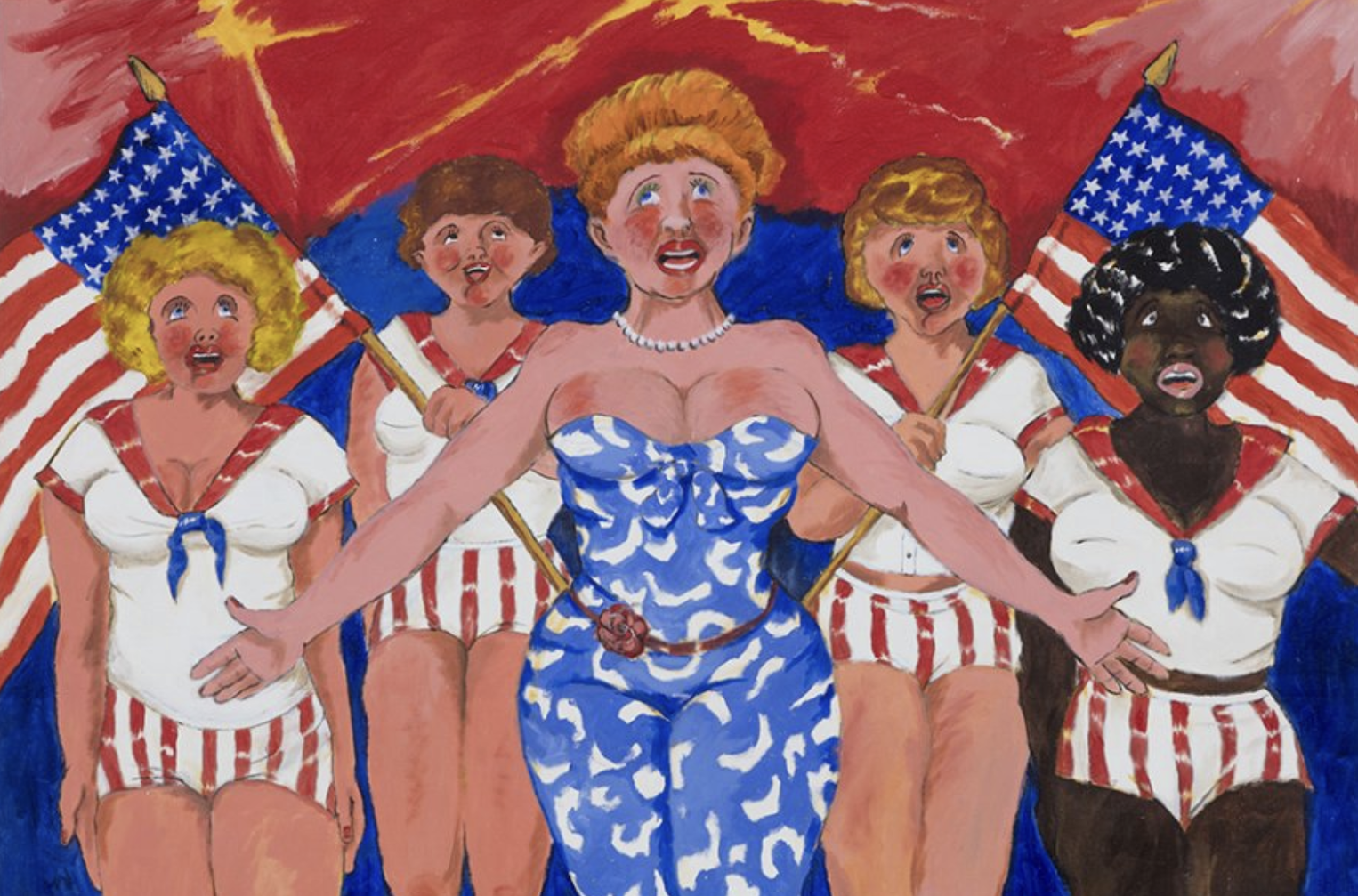
Robert Colescott, Bombs Bursting in Air, 1978
Black stereotypes derive their shock value from their refusal to be ignored. Though these images may be absent from everyday life, Colescott’s paintings remind us they still lurk in the background, fueled by the system that created them. The market for Black Americana objects and ephemera exploited these stereotypes as a cash cow, sustaining a capitalist system that profits from racism. The n-word had all but disappeared from American cultural discourse—so completely that even referencing it could cost someone their job, a level of accountability my Georgia-born parents could scarcely have imagined. Inevitably, the controversy has lost its cultural caché. We now inhabit a political climate hell-bent on resurrecting the propaganda of a “whites-only” America—a lie built on the ugly, exaggerated Black stereotypes used to demonize outsiders and uphold power.
Colescott’s art serves as a bullhorn, amplifying stereotypes as a coercive foundation of white supremacist ideology. He recognized that many white viewers, feeling implicated, responded with defensiveness rather than facing this reality. As Colescott explains:
"There were white people who were offended because they felt guilty because their people had created these images. And so there were white people that felt threatened by these paintings, which monumentalized these perceptions. We've already come to understand that it's about white perceptions of black people. And they may not be pretty. And they may be stupid. We didn't make up these images. So why should we take the heat?"
Why indeed? On one hand, Colescott’s work carries a “the joke’s on us” irreverence, urging Black viewers to lighten up and succumb to the absurdity. On the other, it calls for sharper awareness: stereotypes distort perception and provoke hyper reactivity, demonstrating that people plant themselves smack in the middle of their own complicity. In Black America, the stigma of inferiority has been perpetuated for so long that it underpins marginalization, injustice, and trauma—the point on which Black identity teeters.