Tolerated Margins of Mess Pt. 2
But African American identity is entangled and cannot be reduced to a single, simple framework. The Financial Times found that roughly 10 percent of Black voters supported Donald Trump in 2020, rising to about 15 percent in 2024. His 2024 victory reflects this segment of support and also signals the presence of African Americans actively working within the MAGA-aligned White House—occupying roles that directly participate in supporting a bigot’s political power. Candace Owens—a so-called political pundit—and talk show host Larry Elder were anointed as the Black “faces” of conservatism by a Republican Party now defined by MAGA. Owens claims she has split from Trump and capitalizes on an America First identity while trafficking “red pill” conspiracy theories to millions of followers—and turning that audience into millions of dollars. Owens and Elder’s overt public allegiance to the far right reduces cultural representation to fiction. Enslavement does not presuppose shackling bodies with iron chains. Enslavement also manifests as belief. The great irony is that some black people are willing to accept and epitomize the racist systems in which the conditions of their oppression were developed.
Rather than judging Owens, Colescott would have made art that turned on the irony of her embrace of MAGA delusions. Her carefully constructed “America First” persona, complete with “red pill” conspiracies, offered ample fodder to portray her as a dangerously seductive vixen and, at the same time, a self-made spectacle. Colescott understood Black identity is nebulous—a question without an answer. Yet his generous question, “Why should we take the heat?” hints at leniency, even as his trickster persona insists on self-accountability. Still, the friction between Black and white people over accountability has intensified. Who steps forward—and who retreats? Many African Americans place the burden of change on white people, a view civil rights legislation appears to reinforce but in the end, this expectation often amounts to a pipe dream; those deeply invested in hatred rarely change.
The Dalai Lama has observed, “Pain is inevitable; suffering is optional.” In a similar vein, Colescott’s work conveys a related sentiment: stereotypes may cause pain, but taking offense is optional. His art offers a form of tough love—suggesting that to take offense is to step into a role scripted by white supremacy. As Colescott himself put it:
“…It's satire. It's the satire that kills the serpent, you know."
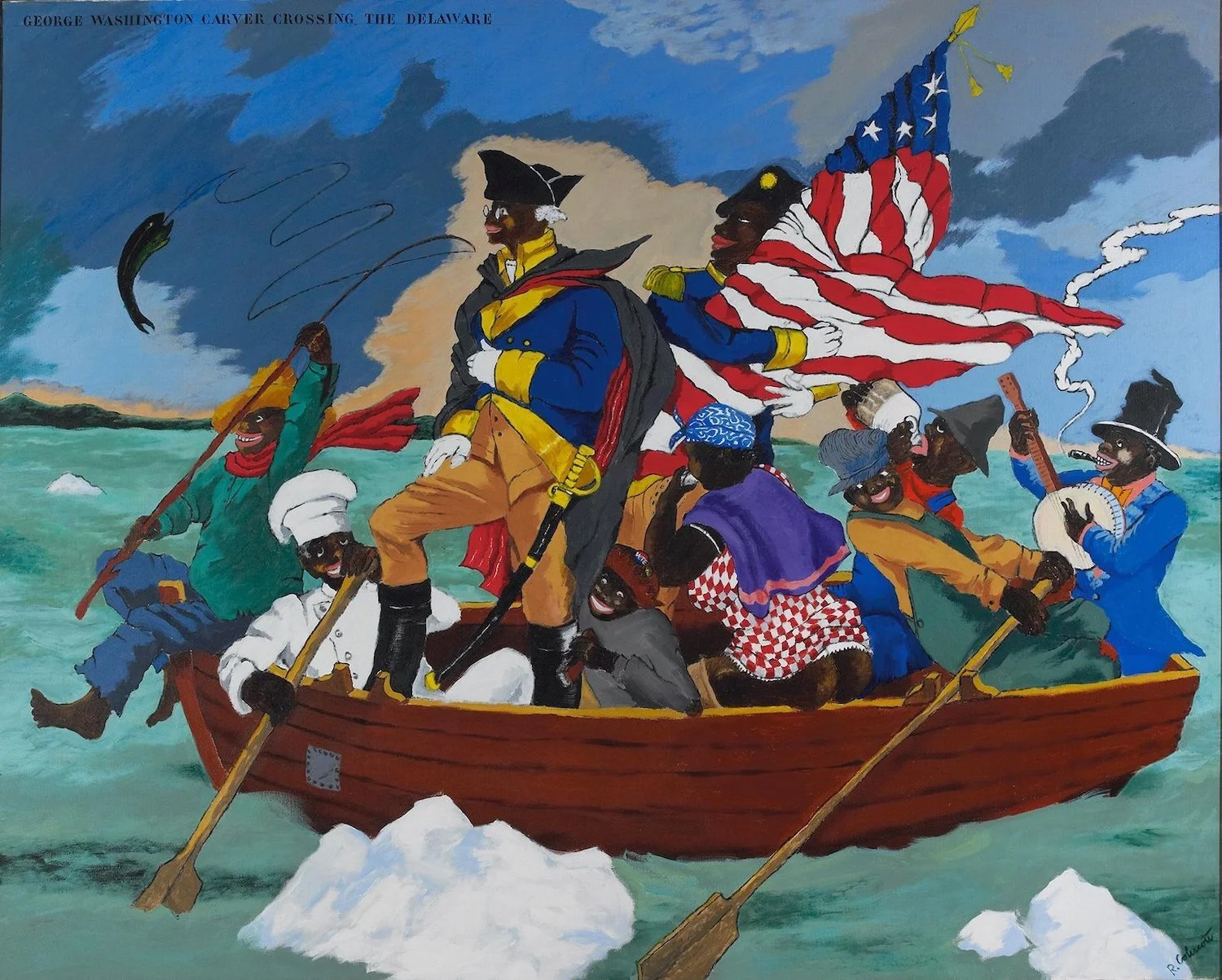
George Washington Carver Crossing the Delaware: Page From An American History Textbook, 1975
Kill is the operative word here. This leads into the disorienting terrain of satire, where logic gives way to provocation. Because we are conditioned to see and be seen through one another in the search for validation and meaning, the emotional charge of stereotypes reveals how deeply they are embedded. We believe what we’re seeing. Colescott’s satire draws on this very charge to jolt us awake, revealing how easily we mistake our reactions for truth. Satire, in turn, exposes an uncomfortable reality: stereotypes function as instruments of deliberate manipulation, and provoking offense is the point. This raises an unavoidable question: how, exactly, does one kill a stereotype—and how do we kill the n-word? Satire is a language we must learn, a language that can be weaponized. In Colescott’s margins of mess, they die—if we can speak it well enough, once and for all.
Terry Gross, the host of NPR's Fresh Air said, “Art helps with the personal, the societal, all the things that trouble us, all the things we’re ashamed by and don’t want to, or can’t talk about.” Colescott’s nonconformist stance demands a countercultural confrontation—one that shatters illusions, strips away entrenched myths about society, and forces difficult conversations often left buried. In this way, satire does more than provoke; it destabilizes what we’ve been conditioned to regard as fixed or normal. Within the tangled mess, stereotypes become maps to otherwise hidden, constructed worlds, the systems that sustain social divisions and our estrangement from ourselves. The discomfort that follows can serve as a powerful catalyst for shedding what does not serve us—a gateway to transcendence through self-determination. We resist the journey that stereotypes invite, sidestepping the reckoning with the flawed lessons we’ve absorbed about race and identity. How inconvenient. Our culture is addicted to looking away.
Furthermore, I believe that an artist’s responsibility is to break with tradition. In a society that treats our worst impulses as virtues to emulate, I view Colescott’s stereotypes as portals in which to reimagine new societies where innovation defines the collective imagination rather than inherited presumptions. There, identity is shaped by individual free will rather than by expectations of cultural representation, class, and the buzzwords routinely heralded in the influencerverse. Where norms are cultivated within broadmindedness, compassion, and wisdom. Then—and only then—can we evolve into a country where egalitarianism is recognized as a birthright, and where all people are POC (People of Consciousness). From this perspective we can reclaim our humanity.
What are you ready to release? What version of yourself are you hoping to grow into? Every life we live offers a space for change. Herein lies the power of Robert Colescott’s tolerated margins of mess—the threshold of evolution. It would behoove us to follow him into the muck, allowing it to unravel the certainties we cling to, until we emerge transfigured—one painting at a time, reborn in insight and possibility.